Research Objectives
Defining Our Goals
The aim of this study is to reconstruct the structural and kinematic evolution of the Bistrița half-window in the East Carpathians. To achieve this, the study pursues the following objectives:
-
To identify and map the main regional faults, shear zones, and folds using existing geological maps and detailed field observations.
-
To document the kinematics of brittle deformation structures and determine the sense of shear along faults and shear zones.
-
To establish the relative timing of deformation, distinguishing between pre-kinematic, syn-kinematic, and post-kinematic sedimentary successions.
-
To evaluate the role of strain partitioning in the distribution and modification of structures, and to address its implications for stress-field reconstructions.
-
To reconstruct the progressive development of scale-folds through rotations, tilting, and fold-related mechanisms.
-
To integrate field data with borehole stratigraphy and seismic information in order to construct regional cross-sections and assess subsurface geometry.
Significance of Understanding Regional Scale-Folds
The Bistrița half-window provides a natural laboratory for examining the interaction between faulting, folding, and strain partitioning within the East Carpathian segment of the fold-and-thrust belt. By integrating kinematic indicators with structural mapping, this study addresses the limitations of traditional paleostress reconstructions in settings characterized by heterogeneous strain and large-scale rotations. The reconstruction of scale-fold development contributes to a better understanding of progressive deformation mechanisms such as fault-bend folding, décollement folds, and hinge-collapse structures. Moreover, the combination of field observations with borehole and seismic data refines regional cross-section building and highlights the structural uncertainties inherent to steeply dipping successions. These results provide new insights into the spatio-temporal evolution of thin-skinned thrust systems in the Carpathians and offer a framework applicable to analogous orogenic belts worldwide.
By comprehensively studying these geological features, we can better predict and mitigate the impacts of natural disasters, optimize resource extraction, and contribute to the broader scientific understanding of Earth’s dynamic systems.
Research Methodology
Methodological Framework
The methodological approach combines existing cartographic data, systematic field observations, and subsurface information in order to reconstruct the structural and kinematic evolution of the Bistrița half-window.
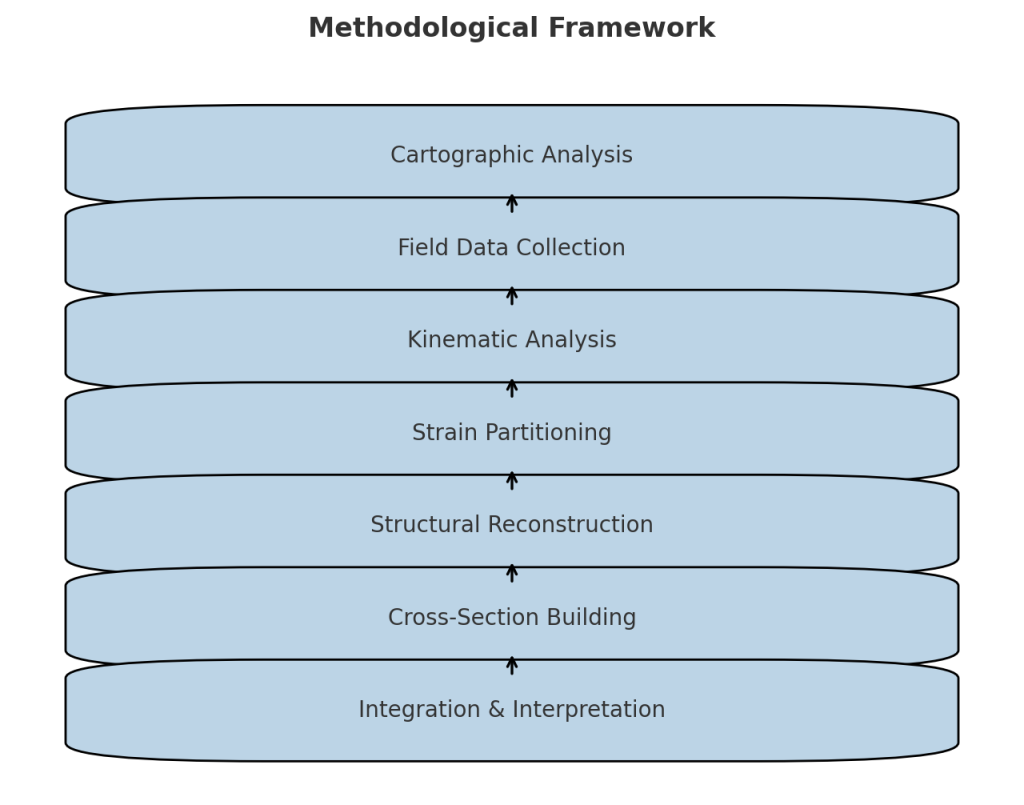
Methodological framework applied in the Bistrița half-window study. The workflow integrates cartographic analysis, field data collection, and kinematic analysis with a strain-partitioning approach, followed by structural reconstruction, cross-section building, and final integration into regional interpretations.
- Methodological framework applied in the Bistrița half-window study. The workflow integrates cartographic analysis, field data collection, and kinematic analysis with a strain-partitioning approach, followed by structural reconstruction, cross-section building, and final integration into regional interpretations.[/caption]
Anticipated Outcomes
Expected Contributions
This research is poised to significantly advance our understanding of geological folding processes, offering new insights into the formation of regional scale-folds. We anticipate that our findings will refine existing geological models and contribute to more accurate predictions of fold behavior in various geological settings. Additionally, the project aims to provide valuable data that can be utilized by geologists worldwide, enhancing the collective knowledge base of structural geology. Our work is expected to foster further research and collaboration in the field, paving the way for innovative approaches to studying geological formations.
By elucidating the mechanisms behind fold formation, our research will support the development of more effective exploration strategies for natural resources, such as hydrocarbons and minerals, which are often associated with folded geological structures. The project’s outcomes will also have implications for understanding seismic activity related to folding, potentially informing risk assessments and mitigation strategies in tectonically active regions. Overall, the research will contribute to both academic and practical applications within the field of geology.
Our findings will be disseminated through publications in leading scientific journals and presentations at international conferences, ensuring that the knowledge gained is shared with the global scientific community. We also plan to engage with educational institutions to incorporate our research insights into geology curricula, inspiring the next generation of geologists. Through these efforts, we aim to establish Structo 2025 as a leader in geological research and innovation.